
Category: Revit
-
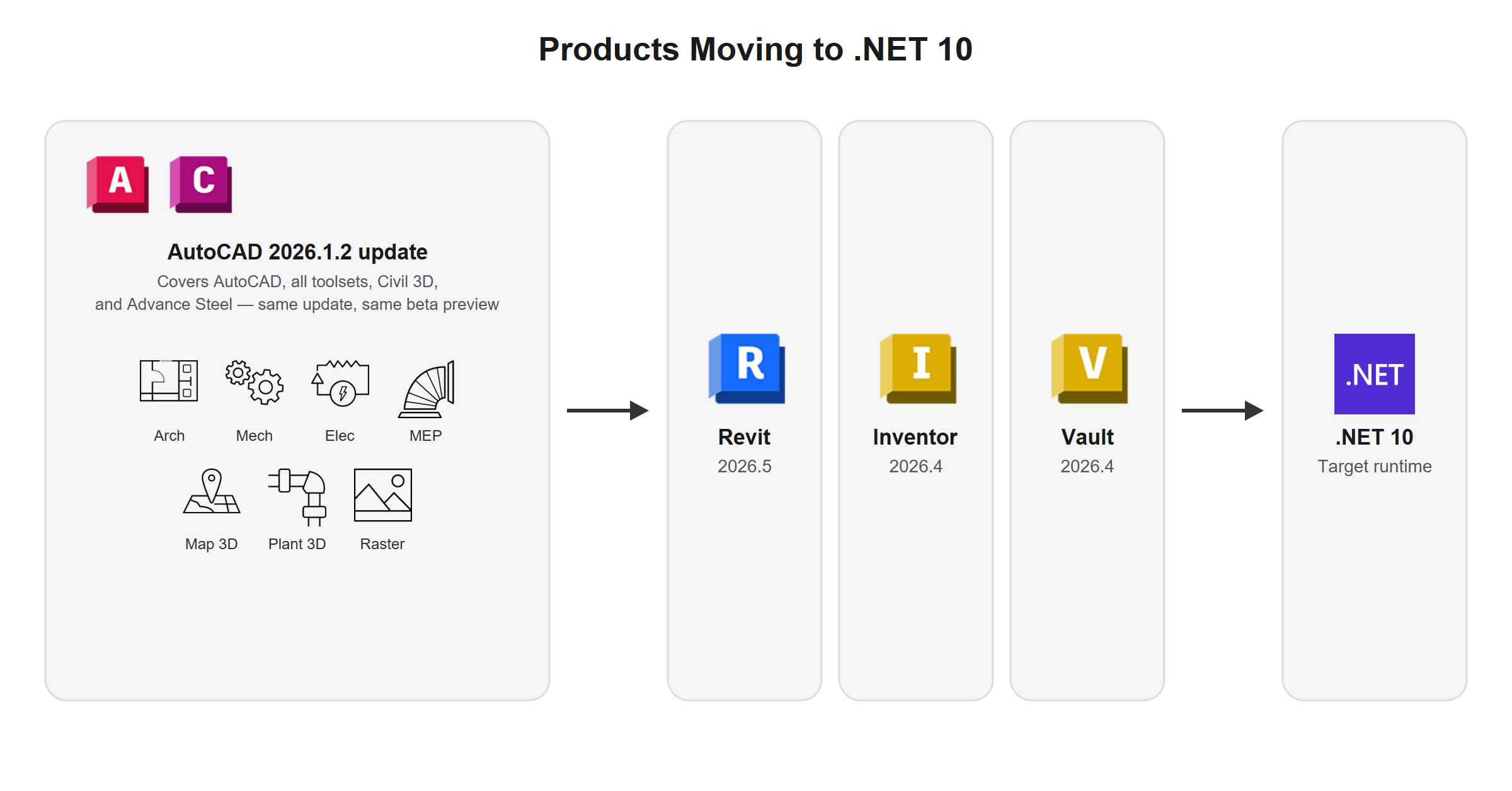
Autodesk Desktop Products 2025/2026: .NET 10 Updates
Microsoft has announced that .NET 8 and .NET 9 will reach end of support on November 10, 2026. After this date, Microsoft will no longer provide updates, including security fixes or technical support, for these versions. To stay current and secure, Autodesk products are updating their .NET dependency to .NET 10 across the 2026 and…
-
Revit API: Understanding Cross-Document Material Handling in DirectShape.SetShape()
If you’ve ever tried to update a DirectShape element’s geometry across two Revit documents and watched the material silently revert to something unexpected, you’re not alone. This is a subtle behavior of the Revit API that catches many developers off guard. Understanding why it happens is the key to working around it correctly — and…
-

Call for Preview Testing: Revit 2026/2025 Migration to .NET 10
Attention Revit Add-in Developers! Autodesk is planning to migrate Revit 2025 and 2026 to .NET 10. We need your help test your application against Revit on .NET 10. Revit 2025 and 2026 are built on .NET 8. As many of you are aware, Microsoft is ending support for .NET 8 on November 10, 2026. .NET…
-

Revit 2027 SDK: .NET 10, API Changes and Additions
Following the evolution of the Revit platform over recent releases, Revit 2027 represents a significant step forward in both platform modernization and API design. This release continues a broader effort to simplify APIs, improve extensibility, and better align Revit with modern development practices. The Revit 2027 SDK is now available and can be downloaded from…
-
Guardrails for Using AI in Autodesk Plugin Development
This post outlines curated guardrails for the effective use of Copilot and other agentic AI tools when developing plugins and extensions for Autodesk authoring applications such as AutoCAD, Revit, and Inventor. I used ChatGPT to help refine the wording. Consider it quiet LLM cannibalism. :) These guardrails can be enforced by placing them in your…
-
Revit API: Extensible Storage — Syncing, Conflicts, and Best-Practice Behaviors
By Naveen Kumar Extensible Storage (ES) is one of the most powerful features in the Revit API. It lets developers attach custom structured data to elements in ways normal parameters can’t. But how does this custom data behave inside a real-world worksharing environment? What about performance, conflicts with other add-ins, or version upgrades? And can this…
-
Revit API: Understanding the Role of SeriesMin and SeriesMax in Plugin Deployment
By Naveen Kumar If you’re developing a Revit plugin with the goal of ensuring compatibility across multiple Revit versions (e.g., 2023 through 2026), you’ve likely come across the SeriesMin and SeriesMax attributes in the PackageContents.xml file. This article explains what these attributes are, why they are important, and the key limitations to be aware of…
-
Jeremy’s Retirement, Continuation of the Blog, Revit SDK 2026.2
By Pedro Nadal Jeremy’s Retirement and continuation of the Blog Revit 2026.2 SDK release API additions CefSharp Removal Jeremy’s Retirement and continuation of the Blog After almost 17 years at the forefront of the Revit developer community, Jeremy Tammik has officially stepped into retirement. For many in the AEC and developer space, The Building Coder…
-
AI Agents and Selfies at DevCon 2025
DevCon 2025 Amsterdam was a great success – Main topic: agents using data – Cyrille’s Summary of Day Two – Kean’s event overview – Teammate monster selfies – More hellos and normal selfies…
-
DevCon 2025, Developer Guide, AI, AI, and AI
I am in Amsterdam today, participating in the DevCon 2025 – Shared projects for multi-version add-in – Revit 2026 Developer Guide – Revit API and SDK documentation RAG – Revit-IFC DeepWiki – RevitGeminiRAG – Yet another Revit MCP – A2A and MCP towards implicit programming – AutoGenLib on-the-fly coding – M$ and Google code 30%…
You must be logged in to post a comment.